
The Science of Storytelling by Muse Storyfirst
Introduction

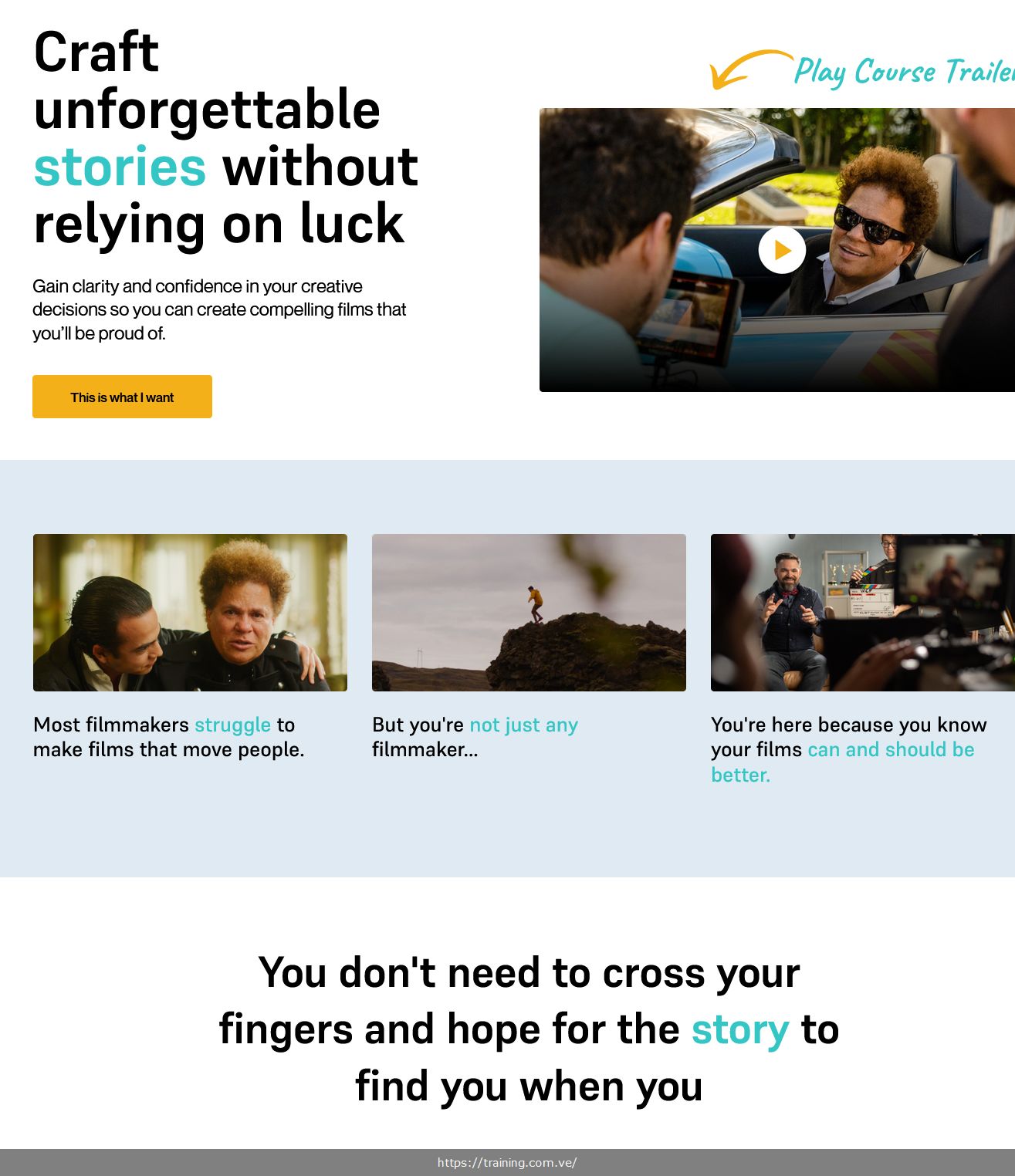
The Science of Storytelling is a comprehensive filmmaking course created by Patrick Moreau and the Emmy-winning team at Muse Storyfirst, designed to teach documentary and commercial filmmakers the science-backed methodology behind creating stories that authentically connect with audiences and drive meaningful action. This 3-module program combines academic research on narrative psychology with practical filmmaking techniques, teaching you how to develop remarkable stories using the proven Muse Process that has been taught to the United Nations, Apple, and over 10,000 filmmakers worldwide.
Here's Everything You'll Receive
📊 Course Stats:
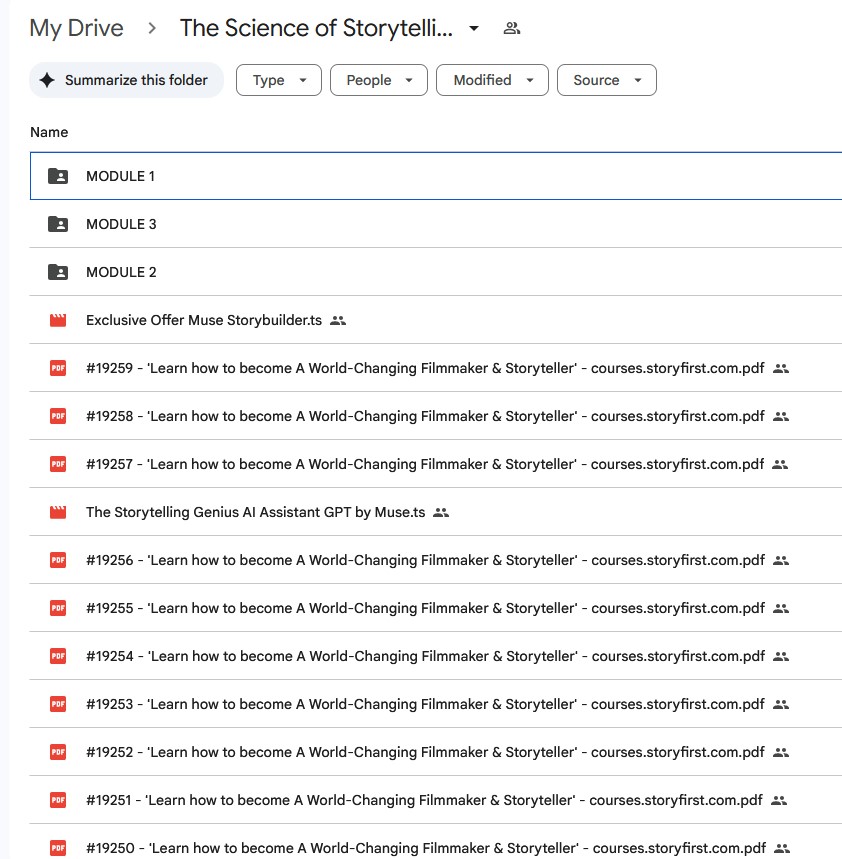
26 video lessons | 74 downloadable PDFs | 1 image | 4h 14m of video content | 3.44 GB total
✅ Module 1: The Foundation of Story Science — 8 video lessons (1h 18m) covering the neuroscience of attention, the psychology of desire, the Four Pillars of Story framework, and an introduction to the Muse Process backed by academic research papers on narrative persuasion and identification.
✅ Module 2: The Storyfinding Process — 8 video lessons (1h 2m) teaching you the step-by-step Storyfinding methodology, including how to identify compelling characters, discover authentic plot through curiosity, articulate purpose through keywords, and master the 7 Types of Stories framework with character tracking tools.
✅ Module 3: The Creative Development Process — 8 video lessons (1h 26m) guiding you through the Three Creative Milestones: developing story keywords, choosing your lead character, building storyboards, crafting hooks and jabs, and wrapping plot in place with sample storyboards and character briefs.
✅ 74 Downloadable Resources — Complete transcripts for every lesson, academic research papers on narrative psychology, the comprehensive Muse Storyfinding Manual 2023, character tracking spreadsheet, outreach templates, ultimate list of storyfinding questions, sample character briefs and storyboards, keyword development worksheets, and documentation on Schwartz's model of human values.
✅ Bonus Content — Exclusive video on the Muse Storybuilder tool and introduction to the Storytelling Genius AI Assistant GPT developed by Muse.
> Note: This includes all recorded training content, video lessons, workbooks, templates, and downloadable resources from the program.
Why Choose CoursesDrop?
✅ 10+ Years of Trust — Delivering digital courses to students worldwide since 2014
✅ Complete & Verified Content — Every module and bonus included, or your money back
✅ 30-Day Money-Back Guarantee — Not satisfied? Full refund, no questions asked
✅ Instant Access — Download your course within minutes of purchase
✅ Secure Checkout — Protected transactions via PayPal & Stripe with SSL encryption
What You Will Master in The Science of Storytelling
✅ Apply the neuroscience of attention and narrative transportation — Understand how stories physically change brain chemistry and use narrative persuasion techniques backed by academic research to make your audience enter the story world and shift their opinions.
✅ Master the Four Pillars of Story framework — Learn how to build stories on the foundation of People (character and desire), Places (authenticity and trust), Purpose (your “why” and keywords), and Plot (curiosity and engagement) that Patrick Moreau has refined over 5 Emmy-winning projects.
✅ Execute the Muse Storyfinding Process — Apply the systematic methodology for discovering authentic stories by identifying the “Big 3 Things” about your subjects, uncovering plot through curiosity rather than scripting, and finding places that create trust with your audience.
✅ Develop compelling lead characters — Choose and develop characters using identification psychology and sympathy research, understanding character roles beyond just the protagonist, and tracking character development through the provided spreadsheet system.
✅ Articulate purpose through story keywords — Use the Schwartz model of human values to identify the core keywords that will make your story memorable and actionable, ensuring your message resonates and drives audience response.
✅ Structure stories using the 7 Types framework — Identify which of the 7 story archetypes best fits your subject and use the appropriate structure to maximize audience connection and impact.
✅ Build professional storyboards — Translate your storyfinding discoveries into visual storyboards using the Three Creative Milestones system, with templates and sample storyboards showing the complete development process.
✅ Craft hooks and jabs that grab attention — Apply plot point flexibility to create openings that immediately engage your audience and use mini-wins and setbacks throughout your character's journey to maintain engagement.
✅ Reduce overwhelm with systematic process — Replace guesswork and creative paralysis with a proven step-by-step structure that frees your creativity and gives you confidence in every storytelling decision.
✅ Position yourself as a strategic partner — Move from “hired tripod” to strategic storytelling partner by articulating your process, demonstrating your understanding of story science, and commanding higher budgets through your expertise.
✅ Create films that drive impactful action — Structure your narratives so audiences leave ready to take meaningful action, using the psychology of desire and purpose-driven storytelling to create real-world change.
✅ Apply academic storytelling research to real projects — Integrate findings from peer-reviewed studies on narrative persuasion, character identification, sympathy and callousness, and media psychology into your commercial and documentary work.
Who Is This Course For?
- The Documentary Filmmaker Struggling with Structure — You're passionate about important subjects but your films feel unfocused or fail to engage audiences the way you envisioned. You've tried traditional three-act structure but it feels forced for real-life stories. This course gives you the Storyfinding Process to discover authentic plot through curiosity rather than imposing artificial narrative, plus the Four Pillars framework to ensure every documentary has the elements that make audiences connect emotionally and take action.
- The Commercial Filmmaker Stuck in “Hired Tripod” Mode — You're making decent money shooting corporate videos and brand content, but clients see you as a technician rather than a strategic partner, limiting your creative input and keeping your rates stagnant. You've tried pitching creative ideas but lack the vocabulary to articulate why your approach works. This course teaches you the science-backed Muse Process that has been taught to Apple and Four Seasons, giving you the credibility and systematic methodology to position yourself as a storytelling strategist who commands premium budgets.
- The Film School Graduate Seeking Practical Application — You spent years learning film theory and technical skills but find yourself paralyzed when facing real projects, unsure how to translate abstract concepts into compelling stories. Academic training taught you about narrative structure but not the systematic process for finding stories in the real world. This course bridges that gap with the step-by-step Storyfinding methodology, character tracking systems, and practical templates that show you exactly how to develop stories from scratch.
- The Brand Storyteller Wanting Measurable Impact — You create content for nonprofits, social enterprises, or mission-driven brands but struggle to prove your films are actually changing minds or driving behavior. You understand emotional storytelling but lack the framework to explain why certain stories work and others don't. This course grounds your work in narrative psychology research, teaching you how narrative transportation and character identification measurably shift audience opinions, plus the Purpose pillar that ensures your films drive impactful action.
- The Experienced Filmmaker Facing Creative Burnout — You've been making films for years and have a strong portfolio, but every project feels like reinventing the wheel, leading to creative overwhelm and diminishing passion. You know storytelling intuitively but lack a repeatable system, making each project exhausting. This course gives you the structure that frees your creativity, reducing overwhelm with a proven process while deepening your craft with academic insights on why stories work at the neurological and psychological level.
- The Content Creator Transitioning to Longer Format — You've built an audience creating short social content or YouTube videos but want to develop documentary or long-form branded content that requires deeper storytelling craft. Your current approach of quick cuts and viral hooks doesn't translate to 10-30 minute narratives that need character development and sustained engagement. This course teaches you the Muse Storyboarding system and plot architecture specifically designed for longer formats, plus the 7 Types of Stories framework to choose the right structure for each project.
- The Nonprofit Communications Professional Learning Visual Storytelling — Your organization needs compelling films to attract donors, volunteers, and awareness but you're transitioning from writing or communications into video production. You understand your mission but don't know how to translate it into visual narrative that creates the trust and emotional connection required for fundraising success. This course teaches you the Places pillar (authenticity that creates trust) and the Keywords system for ensuring your purpose resonates, with templates and processes designed for mission-driven storytelling.
A Lesson-by-Lesson Breakdown of the Curriculum
Module 1: The Foundation of Story Science
This module establishes the scientific foundation for why stories work at the neurological and psychological level, introducing you to the Four Pillars framework and the Muse Process backed by academic research on narrative persuasion.
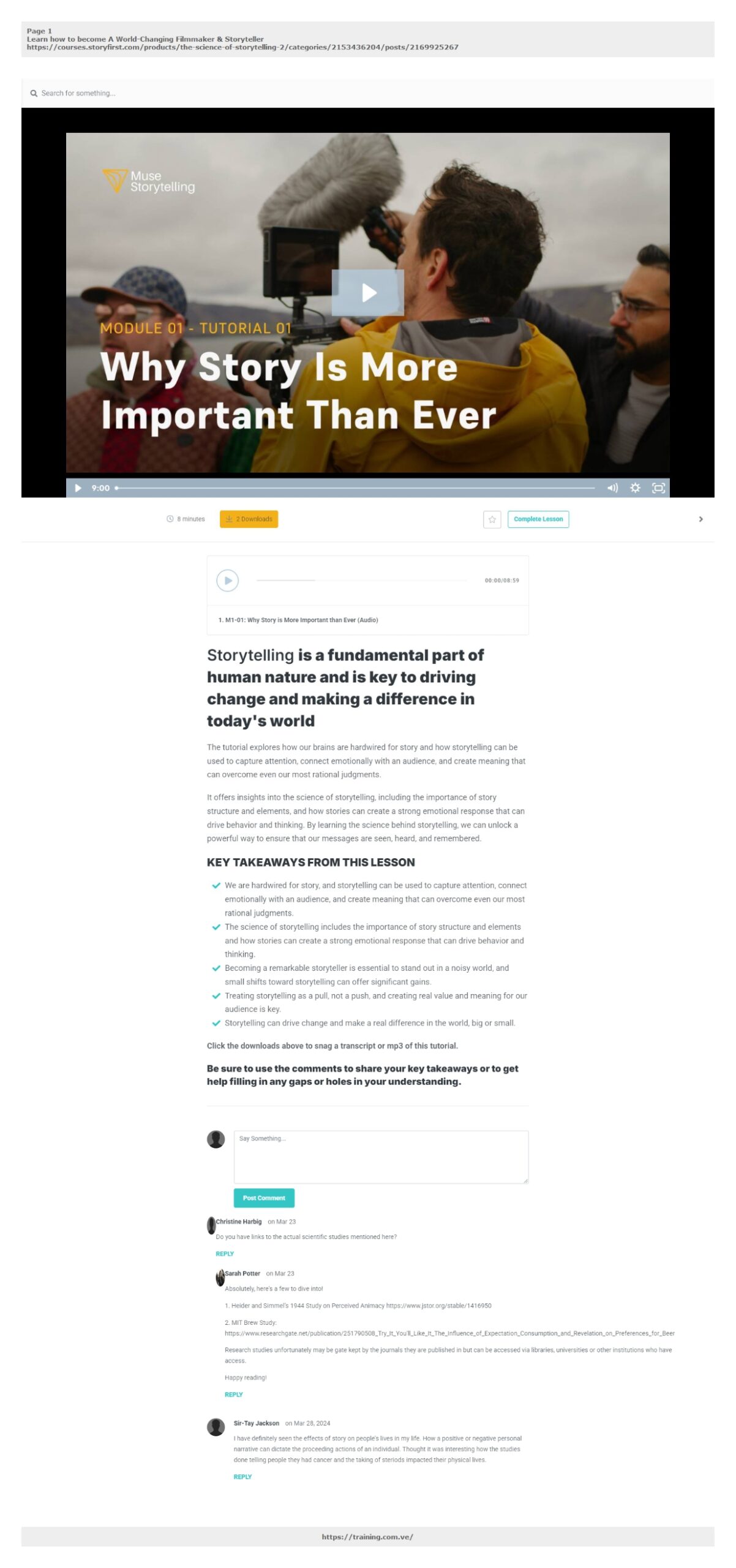
- Lesson 1.1: Why Story is More Important than Ever
- Lesson 1.2: What Exactly Is A Story
- Lesson 1.3: Who You're Learning From
- Lesson 1.4: Two Critical Forces in Story
- Lesson 1.5: The Four Pillars Of Story
- Lesson 1.6: The Science of Storytelling
- Lesson 1.7: The Science of Storytelling (Advanced Concepts)
- Lesson 1.8: An Overview Of The Process
- 📕 Included resources: Complete transcripts for all 8 lessons, academic research papers including “A Conceptual Framework of Narrative Persuasion,” “Media Psychology Article,” “Enhancing Attitudes Toward Stigmatized Groups With Movies: Mediating and Moderating Processes of Narrative Persuasion,” “Identification and Perspective,” “Not Whodunit But Whydunit: Story Characters Motivations Influence Audience Interest in Services,” and “Sympathy and Callousness”
Module 2: The Storyfinding Process
This module teaches the systematic Storyfinding methodology that distinguishes Muse's approach — how to discover authentic stories in the real world by identifying compelling people, uncovering plot through curiosity, articulating purpose through keywords, and finding places that create trust.
- Lesson 2.1: Shifting Your Approach to Filmmaking
- Lesson 2.2: Storyfinding 101
- Lesson 2.3: People As The Big 3 Things
- Lesson 2.4: Plot As Curiosity
- Lesson 2.5: Purpose as the Keywords
- Lesson 2.6: Places As Authenticity
- Lesson 2.7: Step By Step Storyfinding Process Walkthrough
- Lesson 2.8: The 7 Types Of Stories
- 📕 Included resources: Complete transcripts for all 8 lessons, comprehensive “Muse Storyfinding Manual 2023,” “7 Types of Story Overview” PDF, “Character Tracking Guide,” “Character Tracking Spreadsheet” (Excel format), “Outreach Templates” for initial subject interviews, “Ultimate List of Storyfinding Questions,” and “Schwartz's Model of Human Values Examples”
Module 3: The Creative Development Process
This module guides you through the Three Creative Milestones of translating your storyfinding discoveries into structured narratives: developing story keywords, choosing your lead character and additional character roles, building storyboards, crafting hooks and jabs, and wrapping plot in place.
- Lesson 3.1: The Three Creative Milestones
- Lesson 3.2: Developing your Story Keywords
- Lesson 3.3: Choosing Your Lead Character
- Lesson 3.4: Additional Character Roles
- Lesson 3.5: Developing Your Storyboards
- Lesson 3.6: The Hook and Jab
- Lesson 3.7: Wrapping Plot In Place
- Lesson 3.8: Making Your First Film With Muse
- 📕 Included resources: Complete transcripts for all 8 lessons, “WCF Character Brief” template with sample, “WCF Keywords” worksheet with sample, “WCF Creative Milestone 3 Storyboards” printable template, professional “Sample Storyboards: I Am Dust” (complete storyboard example showing the full development process)
Bonus Section: Advanced Tools
Additional training on leveraging Muse's technology tools to accelerate your storytelling development and implementation.
- Bonus Video 1: Exclusive Offer — Muse Storybuilder
- Bonus Video 2: The Storytelling Genius AI Assistant GPT by Muse
Included Bonus Materials to Accelerate Your Results
✅ Muse Storyfinding Manual 2023 — The complete written guide to the Storyfinding Process with detailed explanations, examples, and step-by-step instructions (comprehensive PDF resource).
✅ Character Tracking System — Both a detailed guide and Excel spreadsheet for tracking character development throughout your storyfinding and production process, ensuring consistency and depth in your character work.
✅ Ultimate List of Storyfinding Questions — Comprehensive question bank organized by the Four Pillars to guide your subject interviews and discovery process, eliminating the guesswork in pre-production.
✅ Outreach Templates — Professional email and communication templates for approaching potential subjects, explaining the Storyfinding Process, and building trust before filming begins.
✅ Sample Storyboards: I Am Dust — Complete professional storyboard example showing how to translate storyfinding into visual planning, with detailed shot descriptions and narrative flow (11+ MB comprehensive sample).
✅ Character Brief Templates with Samples — The WCF Character Brief template used by Muse Storytelling on client projects, plus a filled sample showing exactly how to document character development, including the Big 3 Things, keywords, and character arc.
✅ Story Keywords Development System — The WCF Keywords worksheet with sample showing how to apply Schwartz's model of human values to identify the core 2-3 keywords that will make your story memorable and drive audience action.
✅ Academic Research Papers — Six peer-reviewed academic papers that form the scientific foundation of the Muse Process, including research on narrative persuasion, media psychology, identification theory, character motivation influence, and sympathy research.
✅ Storyboard Templates for Printing — Print-ready storyboard templates (Creative Milestone 3) formatted for professional client presentations and personal project planning.
✅ 7 Types of Story Framework Guide — Detailed overview of the 7 story archetypes with examples and guidance on which type best fits different subjects and project goals.
✅ Storytelling Genius AI Assistant Introduction — Training on how to use Muse's custom GPT to accelerate story development, get feedback on story structure, and solve storytelling challenges using AI trained on the Muse Process.
About Your Instructor: Patrick Moreau and Muse Storyfirst

Patrick Moreau is a 5-time National Emmy Award-winning filmmaker and the founder of Muse Storytelling, a storytelling education company and production studio known for creating films that combine cinematic excellence with measurable social impact. What distinguishes Patrick's approach is his commitment to grounding filmmaking education in academic research on narrative psychology — studying peer-reviewed journals on how stories neurologically change audiences, then translating that science into practical methodology that working filmmakers can apply immediately.
Key Credentials & Accomplishments:
✅ 5-time National Emmy Award winner — Recognized for excellence in documentary storytelling and narrative craft across multiple Emmy-winning projects.
✅ Lead storytelling partner for Four Seasons Hotels & Resorts — Created over 100 films at dozens of Four Seasons properties worldwide, including their most-viewed film of all-time, establishing Muse as the trusted storytelling partner for one of the world's most prestigious luxury brands.
✅ Taught at the United Nations and Apple — The Muse Process has been privately taught to iconic organizations including the United Nations in Geneva, Apple, NFL, and Fujifilm, validating the methodology at the highest institutional level.
✅ Educated over 10,000 filmmakers in 30+ countries — Through workshops, courses, and the Filmmaker Freedom Mentorship program, Patrick has built educational programs that reach filmmakers globally, with participants noting the training was more valuable than their four-year film degrees.
✅ Featured in major filmmaker publications — Including interviews in No Film School, ProVideo Coalition, CineD, and Filmmakers Academy discussing the science of storytelling and the Muse methodology.
✅ Co-founder of StillMotion — Built one of the industry's most respected filmmaking education and production brands before founding Muse Storytelling.
✅ Researcher and academic contributor — Not just a filmmaker but also a researcher who has delved into the science of storytelling, studying findings from academic journals and applying narrative psychology research to practical filmmaking education.
✅ Creator of multiple filmmaker education programs — Beyond The Science of Storytelling, Patrick has developed Filmmaker Freedom Mentorship, Storyfinding Hero, Cinematic Filmmaking courses, and the AI Masterclass for Filmmakers, building a comprehensive ecosystem of filmmaker education.
✅ Producer of original documentaries — Currently producing an original documentary on the life of Romero Britto (the most licensed artist in history), crowdfunded for over $2 million, demonstrating the application of the Muse Process to high-stakes original content.
✅ Featured podcast guest and interview subject — Appeared on Studio Sherpas' “Grow Your Video Business” podcast multiple times, Nicholas Kusmich's storytelling series, Live Institute's Crowdcast series sharing “6 Secrets to Storytelling from an Emmy Award-Winning Filmmaker,” and Tiffin Box discussing why storytelling is sacred.
Patrick's mission is rooted in the belief that storytelling is the most powerful tool for creating empathy and driving meaningful action in the world. At Muse, the team is passionate about equipping filmmakers with science-backed skills to tell stories that shift perception and behavior, empowering a generation of storytellers to create films they're proud of while commanding the budgets and creative freedom they deserve.
What Problems Does The Science of Storytelling Solve?
“I know how to shoot beautiful footage but my films don't connect emotionally with audiences” — Module 1 teaches you the neuroscience of attention and narrative psychology research on character identification and narrative transportation, showing you exactly which story elements create emotional connection and why. You'll learn the Four Pillars framework that ensures every film has the structural elements (People, Places, Purpose, Plot) that make audiences feel rather than just watch.
“Every project feels overwhelming because I'm reinventing my process from scratch” — Module 2 gives you the systematic Storyfinding Process that replaces creative paralysis with a repeatable methodology. The step-by-step walkthrough, character tracking spreadsheet, and Ultimate List of Storyfinding Questions provide the structure that frees your creativity and gives you confidence in your storytelling decisions, eliminating the exhausting cycle of starting each project blind.
“I can't articulate to clients why my storytelling approach justifies higher rates” — The course grounds your work in academic research and the same science-backed Muse Process taught to Apple and the United Nations, giving you the credibility and vocabulary to position yourself as a strategic storytelling partner rather than a “hired tripod.” You'll be able to explain narrative persuasion, identification psychology, and the Four Pillars framework with the authority of someone who understands the science behind why stories work.
“My documentary subjects are interesting but I struggle to find the story in real life” — The Storyfinding methodology in Module 2 specifically addresses this challenge by teaching you to discover authentic plot through curiosity rather than imposing scripted narrative. You'll learn to identify the “Big 3 Things” about your subjects, use the 7 Types of Stories framework to recognize which archetype fits, and apply the comprehensive question bank to uncover compelling narrative during pre-production rather than hoping to find it in editing.
“I don't know how to structure longer-form content that maintains engagement” — Module 3's Creative Development Process teaches you the Three Creative Milestones system for building storyboards that sustain engagement across 10-30+ minute films. You'll learn how to craft hooks and jabs using plot point flexibility, structure character journeys with mini-wins and setbacks, and wrap plot in place so your audience stays engaged from opening to impactful close.
“I work with nonprofits and mission-driven brands but can't prove my films drive results” — The course's emphasis on the Purpose pillar and narrative persuasion research gives you the framework to create stories that measurably shift audience opinions and drive action. You'll learn how to use story keywords based on Schwartz's model of human values to ensure your message is memorable, and structure narratives so audiences leave ready to take impactful action rather than just feeling moved.
“I've tried applying three-act structure but it feels forced for my documentary work” — The Muse Process offers a fundamentally different approach: instead of imposing artificial narrative structure, you'll learn to discover authentic plot through the Storyfinding Process, find places that create trust, and use the flexibility of the 7 Types of Stories framework rather than forcing every story into the Hollywood three-act model.
What Makes The Science of Storytelling Different
- Grounded in peer-reviewed academic research — Unlike courses based solely on intuition or Hollywood screenwriting theory, this program includes six academic research papers on narrative persuasion, media psychology, character identification, and sympathy research, translating scientific findings into practical filmmaking methodology you can apply immediately.
- Systematic Storyfinding Process for real-world subjects — While most storytelling courses focus on scripted narrative or abstract theory, Muse teaches a repeatable methodology specifically designed for discovering authentic stories in documentary and commercial work, addressing the unique challenge of finding compelling narrative in real life rather than inventing it.
- Proven at institutional level with Fortune 500 brands — The Muse Process isn't theoretical — it's the same science-backed methodology privately taught to the United Nations, Apple, NFL, Four Seasons, and Fujifilm, and used to create over 100 films for one of the world's most prestigious luxury brands, giving you a system with demonstrated results at the highest level.
- Comprehensive implementation tools beyond video lessons — You receive the complete toolkit used by Muse on client projects: character tracking spreadsheet, ultimate question bank, outreach templates, character brief templates with samples, storyboard templates, and the complete Muse Storyfinding Manual 2023, ensuring you can immediately apply the methodology to your projects rather than just understanding it conceptually.
Frequently Asked Questions About The Science of Storytelling
What is The Science of Storytelling about?
The Science of Storytelling is a comprehensive 3-module filmmaking course that teaches documentary and commercial filmmakers the science-backed Muse Process for developing stories that authentically connect with audiences and drive measurable impact. The course combines academic research on narrative psychology with practical methodology, teaching the Four Pillars of Story framework, the systematic Storyfinding Process for discovering authentic stories in real-world subjects, and the Three Creative Milestones system for developing storyboards and structured narratives.
Who created The Science of Storytelling?
The course was created by Patrick Moreau and the Emmy-winning team at Muse Storyfirst (also known as Muse Storytelling). Patrick is a 5-time National Emmy Award-winning filmmaker who has taught the Muse Process to the United Nations and Apple, served as lead storytelling partner for Four Seasons Hotels & Resorts creating over 100 films, and educated over 10,000 filmmakers in 30+ countries.
What is included in The Science of Storytelling?
The course includes 26 video lessons (4 hours 14 minutes total), 74 downloadable PDFs including complete lesson transcripts, the comprehensive Muse Storyfinding Manual 2023, 6 academic research papers on narrative psychology, character tracking system with spreadsheet, ultimate list of storyfinding questions, outreach templates, sample storyboards (I Am Dust), character brief templates with samples, story keywords development worksheets, 7 Types of Stories framework guide, and bonus training on the Muse Storybuilder tool and Storytelling Genius AI Assistant. Total download size is 3.44 GB.
Who is The Science of Storytelling best suited for?
The course is designed for documentary filmmakers struggling with structure and authentic narrative discovery, commercial filmmakers wanting to position themselves as strategic partners commanding premium budgets, film school graduates seeking practical application of theory, brand storytellers working with nonprofits and mission-driven organizations, experienced filmmakers facing creative burnout who need a repeatable system, content creators transitioning to longer-form narratives, and nonprofit communications professionals learning visual storytelling for fundraising and awareness.
What will I learn in The Science of Storytelling?
You'll master the neuroscience of attention and narrative transportation, the Four Pillars of Story framework (People, Places, Purpose, Plot), the systematic Storyfinding Process for discovering authentic stories, character development using identification psychology, purpose articulation through story keywords and Schwartz's model of human values, the 7 Types of Stories framework for choosing appropriate structure, storyboard development through the Three Creative Milestones, hook and jab techniques for grabbing and maintaining attention, and how to position yourself as a strategic storytelling partner rather than technical vendor.
What format is The Science of Storytelling delivered in?
The course includes 26 video lessons in .TS format (4h 14m total duration), 74 PDF documents including transcripts, research papers, templates, and guides, 1 Excel spreadsheet for character tracking, and 1 image file. The complete package totals 3.44 GB and is organized into 3 modules covering Foundation (1h 18m), Storyfinding Process (1h 2m), and Creative Development (1h 26m), plus bonus content on Muse's technology tools.
Does The Science of Storytelling include any bonus materials?
Yes, the course includes extensive bonus materials: the comprehensive Muse Storyfinding Manual 2023, character tracking system with spreadsheet and guide, Ultimate List of Storyfinding Questions organized by the Four Pillars, professional outreach templates, complete sample storyboards (I Am Dust – 11+ MB), character brief templates with filled samples, story keywords development system with samples, 6 academic research papers forming the scientific foundation, print-ready storyboard templates, 7 Types of Story framework guide, and exclusive training on the Storytelling Genius AI Assistant GPT developed by Muse.
What is Patrick Moreau known for?
Patrick Moreau is known as a 5-time National Emmy Award-winning filmmaker, founder of Muse Storytelling, creator of the science-backed Muse Process for developing remarkable stories, lead storytelling partner for Four Seasons Hotels & Resorts (creating 100+ films including their most-viewed film ever), educator who has taught over 10,000 filmmakers in 30+ countries, instructor to institutional clients including the United Nations and Apple, researcher applying academic narrative psychology to practical filmmaking, co-founder of StillMotion, and advocate for empowering filmmakers to create impactful stories while commanding premium budgets and creative freedom.
How is The Science of Storytelling different from other filmmaking courses?
Unlike courses based on Hollywood screenwriting theory or abstract film school concepts, The Science of Storytelling grounds its methodology in peer-reviewed academic research on narrative psychology, media psychology, and character identification. It teaches a systematic Storyfinding Process specifically designed for discovering authentic stories in real-world subjects (documentary and commercial work) rather than imposing artificial narrative structure. The Muse Process has been proven at institutional level with the United Nations, Apple, and Fortune 500 brands, and the course includes comprehensive implementation tools (tracking spreadsheets, question banks, templates) used on actual client projects rather than just conceptual video lessons.

Sources
- Muse Storytelling
- Story First – Muse Storytelling Academy
- The Science of Storytelling Course Page
- Patrick Moreau LinkedIn Profile
- The Art and Science of Storytelling: Interview With Patrick Moreau
- 6 Secrets to Storytelling from Emmy Award-Winning Filmmaker Patrick Moreau
- Muse: Why Storytelling Should Matter To Filmmakers – Filmmakers Academy
- No Film School: Take Muse's Science of Storytelling Course Online
- Muse Storytelling on MZed – CineD
- Muse Storytelling LinkedIn Company Page